
Table of Contents
- Know Your Grout and Your Stain First
- Tools and Supplies
- Step by Step: How to Clean Deeply Stained Grout
- Best Grout Cleaner for Tough or Old Stains
- Does OxiClean or a Magic Eraser Work on Grout?
- Stain-by-Stain Fixes: Mildew, Rust and Hard Water
- Safety With Chemical Cleaners
- Seal After Cleaning
- How Often to Deep Clean Tile and Grout
- DIY vs. Pro: When to Call Spotless
- Frequently Asked Questions
Last Updated: November 1, 2026
Deeply stained grout usually isn’t a lost cause. Most “permanent” stains are soil, mildew or mineral buildup sitting in porous grout, and the right cleaner, enough dwell time and a good brush will lift a lot more than you expect. This guide walks through how to clean deeply stained grout step by step: how to identify your grout and your stain, which cleaners work on tough or old stains (and which don’t), how to seal afterward, and when it’s time to call a pro.
Know Your Grout and Your Stain First
Picking the wrong cleaner is the fastest way to turn a stain into real damage. Two minutes of diagnosis saves a lot of scrubbing.
Identify Your Grout Type
- Cement grout (most common): porous, matte and slightly chalky. It crumbles a little when scratched with a coin, absorbs water and stains easily. If you aren’t sure, assume cement. It’s the safest default for most homes.
- Epoxy grout: hard, slightly glossy and doesn’t crumble when scratched. It resists stains and moisture far better than cement and is common in newer showers and commercial kitchens.
- Urethane grout: falls between the two in hardness and stain resistance.
Grout type changes the method. Acidic cleaners (vinegar, lemon juice, citric acid) dissolve mineral deposits on cement grout but can etch and dull epoxy. Alkaline cleaners (baking soda, most commercial grout cleaners) are safer on epoxy but slower on mineral stains. Old cement grout can also crack under aggressive scrubbing, while epoxy tolerates a harder brush.
Sealed or Unsealed?
Put a few drops of water on an out-of-the-way grout line. If the water beads up, the grout is sealed. If it darkens and soaks in, it’s unsealed and porous, so it needs gentler scrubbing and stains more deeply.
Check Your Tile, Too
- Glazed ceramic and most porcelain tolerate baking soda paste, oxygen bleach and most commercial grout cleaners. Unglazed porcelain is more porous, so test first.
- Natural stone (marble, travertine, limestone, slate) is acid-sensitive. Vinegar, lemon juice and acidic grout cleaners will etch it. Use a pH-neutral stone cleaner or baking soda paste only.
- Colored grout fades with bleach or repeated high-alkaline cleaners. Test a hidden line first.
Name the Stain
| What you see | What it usually is | First treatment | What to avoid |
|---|---|---|---|
| Black, green or pink spots in damp areas | Mold or mildew | Oxygen bleach or hydrogen peroxide | Chlorine bleach on colored grout |
| White, chalky or crusty film | Hard water or mineral deposits | Acidic cleaner (ceramic or porcelain only) | Acid on natural stone or epoxy |
| Orange or brown streaks | Rust from fixtures or iron in the water | Rust remover made for tile | Oxygen bleach (it won’t lift rust) |
| Gray or brown film in traffic areas | Dirt, grease and soap scum | Baking soda paste or a degreaser | Skipping the rinse |
| Uniform gray or yellow tint | Deep-set soil or aged grout | Oxygen bleach, then evaluate for sealing | Stiff metal brushes |
| Grout that crumbles when scrubbed | Failing grout | Repair or re-grouting | More scrubbing |
Test Before You Commit
Try any new cleaner on a hidden spot first, such as inside a closet, under a vanity or in a corner. Apply it, let it sit for the recommended time, scrub gently, rinse, and check the next day for dulling, fading or pitting. If you see any, don’t use that product on the rest of the floor.
Tools and Supplies
A sponge won’t clean grout. You need stiff bristles that reach into narrow joints without scratching tile.
- Grout brush: stiff nylon bristles, ideally with an angled head. This is your main tool.
- Larger stiff-bristled brush: covers the tile faces between grout lines faster.
- Old toothbrush or electric toothbrush: corners, edges and around fixtures.
- Spray bottle, two buckets (one for cleaner, one for clean rinse water), microfiber cloths and a squeegee.
- Cleaners: baking soda, 3% hydrogen peroxide, dish soap, oxygen bleach powder, and a commercial grout cleaner or rust remover if your stain calls for it.
For safety, wear chemical-resistant gloves and safety glasses, open windows or run the exhaust fan, and keep children and pets out of the room until you’ve rinsed.
Step by Step: How to Clean Deeply Stained Grout
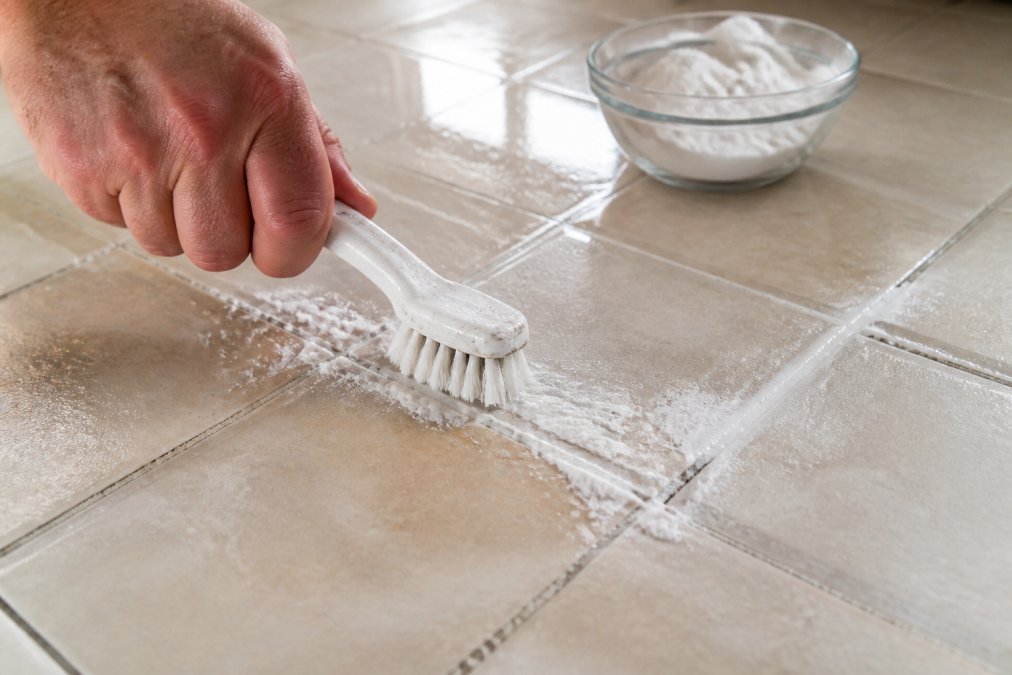
Step 1: Prep the Area
Sweep or vacuum loose debris out of the grout lines. Remove bath mats, bottles and anything porous that could catch overspray. Tape off painted baseboards and wood trim, since cleaners that are fine on ceramic can dull paint or etch stone. Start with dry grout. Wet grout dilutes the cleaner.
Step 2: Apply the Cleaner to the Grout Lines
Work a paste in with a toothbrush, or spray the cleaner directly onto the grout. Coat the full line, not just the visible stain. Don’t flood the tile, because you want the cleaner on the stain, not pooling on the surface. On floors, work in sections of about 3 by 3 feet so the cleaner doesn’t dry before you get to it.
Step 3: Give It Dwell Time
Dwell time is when the chemistry does the work, and rushing it is the biggest reason DIY grout cleaning underperforms. As a rough guide:
- Baking soda and peroxide paste: about 10 to 15 minutes. Re-mist it if it starts to dry.
- Oxygen bleach: follow the label, usually 15 to 30 minutes. Mix it fresh, because activated oxygen loses strength.
- Commercial grout cleaner: follow the label exactly.
If the cleaner dries before you scrub, reapply it. Dried cleaner stops working and leaves residue.
Step 4: Scrub the Grout Lines
Scrub along each grout line with short, firm strokes or small circles. The goal is to lift loosened grime out, not to grind the grout down. Heavily stained sections may need two or three minutes each and a second application.
Step 5: Rinse Completely
Rinse with clean water, not the bucket you mixed cleaner in, until no residue is left. Rinse twice after oxygen bleach or a commercial cleaner. Leftover cleaner attracts dirt and can look worse than the original stain. A wet/dry vacuum or a clean-water mop speeds this up on floors.
Step 6: Dry and Inspect
Squeegee walls, wipe floors and run a fan. Damp grout invites mildew back within days. Then check the grout in good light. If stains remain, repeat the cycle. If grout crumbles or flakes while you scrub, stop. That’s a repair problem, not a cleaning problem.
Best Grout Cleaner for Tough or Old Stains
There’s no single best grout cleaner. The best one is the gentlest product that matches your stain and your tile.
Baking Soda and Hydrogen Peroxide Paste
This is the safest starting point for most grout. Mix about three parts baking soda to one part hydrogen peroxide, plus a few drops of dish soap so it clings to vertical lines. Baking soda is mildly abrasive and alkaline, and peroxide lifts organic discoloration without etching. It works well on dirt, soap scum and light mildew. It won’t do much for rust or heavy mineral buildup.
Oxygen Bleach
Oxygen bleach (sodium percarbonate) is stronger than baking soda paste but much gentler than chlorine bleach. It’s a good choice for set-in organic stains, mildew and grout that looks uniformly dingy. Test it on colored grout first, since it can lighten some dyes.
Acidic Cleaners for Mineral Deposits
Hard water scale and white chalky buildup respond to acid: diluted white vinegar, citric acid or an acidic grout cleaner. Use acid only on cement grout with ceramic or porcelain tile, never on natural stone or epoxy, and use it sparingly, because repeated acid slowly erodes cement grout.
Commercial Alkaline Grout Cleaners
Store-bought alkaline grout cleaners cut grease, soap scum and mildew faster than a DIY paste. Read the label for tile compatibility and dilution, and rinse thoroughly.
Does OxiClean or a Magic Eraser Work on Grout?
OxiClean and Other Oxygen Cleaners
Yes, for the right stains. OxiClean is an oxygen cleaner, and it works well on organic stains such as mildew, dirt and soap scum. To use it on grout:
- Mix it according to the package directions
- Apply it to the grout lines with a spray bottle or brush
- Let it sit for the time on the label, usually 15 to 30 minutes
- Scrub with a stiff brush
- Rinse thoroughly with clean water
It won’t remove rust or hard water deposits, and it can’t restore grout that is permanently discolored.
Magic Eraser (Melamine Foam)
A Magic Eraser works by abrasion, not chemistry. It can take light dirt, scuffs and soap scum off the surface, but it won’t reach stains that have soaked into the grout, and it doesn’t treat mildew, mineral deposits or rust. It’s also abrasive enough to wear down unsealed grout with repeated use. Think of it as a maintenance tool between deep cleanings, used with light pressure.
Stain-by-Stain Fixes: Mildew, Rust and Hard Water
- Mildew and mold: treat with oxygen bleach or hydrogen peroxide and a full 15 to 30 minute dwell. Black marks that survive scrubbing are often staining left behind after the mildew is dead. A second round of oxygen bleach usually lightens them. If it keeps coming back within days, look for a moisture problem such as a leak or poor ventilation.
- Rust: orange or brown streaks come from metal fixtures, cans left on the tile or iron in the water. Use a rust remover labeled safe for tile and grout. Oxygen bleach won’t lift heavy rust.
- Hard water deposits: use a diluted acid on ceramic or porcelain only, then rinse well. On natural stone, use a stone-safe mineral remover instead.
- Grease (kitchens): a degreaser or dish soap in warm water works better than oxygen bleach.
- Discolored grout: if grout is still uniformly dark after two full cleaning cycles, it’s likely permanently discolored, not dirty. Sealing with a color sealer or re-grouting is the fix, not more scrubbing.
Safety With Chemical Cleaners
Never mix cleaners. Bleach plus ammonia makes toxic chloramine gas, and bleach plus vinegar or any acid releases chlorine gas (see the CDC). Hydrogen peroxide plus vinegar forms a corrosive acid. Use one product at a time and rinse between products.
- Ventilate the room while you work and until it dries
- Wear gloves and eye protection when spraying or scrubbing
- Read every label for tile compatibility before you start
- Never use a pressure washer on indoor grout joints. It can blow out grout and damage tile
Seal After Cleaning
Cleaning removes stains, but it doesn’t protect cement grout from the next spill. A penetrating sealer fills the pores so water and dirt sit on top instead of soaking in, which makes the grout easier to clean and slower to stain.
- Let the grout dry completely before sealing. The sealer label says how long.
- Apply the sealer to the grout lines only, following the product directions, and wipe any haze off the tile.
- Reapply as the label recommends. Showers and high-traffic floors usually need it sooner.
- Use the water-drop test from earlier to check whether the sealer is still working.
How Often to Deep Clean Tile and Grout
Routine care keeps buildup from settling in, so you need a deep clean less often:
- Weekly: wipe tile and grout with a damp microfiber cloth and a pH-neutral cleaner
- Monthly: scrub grout lines with a stiff brush and mild dish soap
- Every 3 to 6 months: deep clean bathrooms and kitchens with baking soda paste or oxygen bleach
- Every 6 to 12 months: deep clean lower-traffic areas
Between cleanings, squeegee shower walls after use, run the exhaust fan, wipe spills right away and fix leaks quickly. Water getting under tile causes staining from the inside.
DIY vs. Pro: When to Call Spotless
DIY works well for light to moderate stains in a small area. It’s time to call a pro when:
- Stains haven’t improved after two full cleaning cycles with the right product and dwell time
- Mildew keeps coming back soon after cleaning
- Stains cover a whole bathroom, kitchen or large floor
- You have natural stone tile that needs special handling
- Grout is cracking, crumbling or missing in several places
- You want the best possible result before a home sale or rental turnover
If the stain is permanent but the grout is sound, grout colorant or pens can cover discoloration cosmetically. If grout is cracked or failing, re-grouting is the real fix. A good assessment tells you whether you need cleaning, sealing, repair or replacement, and getting that right costs less than replacing grout that only needed cleaning.
How Spotless handles stained grout: if scrubbing and dwell time haven’t moved the stain, the soil is usually below the surface of the grout. Spotless uses professional cleaning solutions, agitation and high-temperature extraction to lift embedded soil, with grout sealing available, for homes and businesses around Monroe. See a before-and-after from Monroe or a commercial tile and grout project in Madison. Spotless is locally owned, fully insured and has served the area since 2008. Learn more about our tile and grout cleaning in Monroe, GA, or call 678-870-7011 for a free quote.
Frequently Asked Questions
Does hydrogen peroxide really clean grout?
Yes. Hydrogen peroxide lifts organic discoloration from porous grout without etching it. Mixed with baking soda into a thick paste, it also gets a little scrubbing power. Apply the paste, let it sit for about 10 to 15 minutes, scrub with a stiff brush and rinse thoroughly. It works on dirt, soap scum and light mildew, but not on rust or heavy mineral deposits.
Can you use OxiClean or a Magic Eraser on grout?
OxiClean, an oxygen cleaner, is safe on most grout and works well on mildew, dirt and soap scum. Mix it per the label, let it dwell, scrub and rinse, and test colored grout first. A Magic Eraser only removes light surface dirt and scuffs, and it can wear down unsealed grout, so use it with light pressure for maintenance, not deep stains.
What should you not clean grout with?
Avoid chlorine bleach on colored grout, acidic cleaners like vinegar on natural stone or epoxy grout, and steel wool or wire brushes on delicate tile. Never mix cleaners, especially bleach with ammonia or acids, and don’t use a pressure washer on indoor grout joints. Test any new product on a hidden area first.
How often should tile and grout be deep cleaned?
Most homes do well with a deep clean every 6 to 12 months, and every 3 to 6 months for busy bathrooms and kitchens. Weekly wipe-downs and a monthly scrub keep stains from setting in, and sealing the grout after cleaning stretches the time between deep cleans.
When is it time to hire a pro for grout?
Call a pro when stains survive two full cleaning cycles, mildew keeps returning, the area is large, you have natural stone, or grout is cracking or crumbling. Spotless uses high-temperature extraction to lift embedded soil and offers grout sealing. Call 678-870-7011 for a free quote.